Monster Car Builds: From Concept to Reality – Top Custom Creations
There’s something undeniably thrilling about witnessing a car transform from a humble factory model into a roaring, fire-breathing beast. Monster car builds push the boundaries of engineering, creativity, and sheer audacity, turning ordinary vehicles into rolling works of art—or nightmares, depending on who you ask. These builds aren’t just about slapping on a turbocharger or a fresh coat of paint; they’re about reimagining what a car can be, often defying physics and convention in the process. Let’s dive into some of the most jaw-dropping custom creations from around the world, explore the stories behind them, and meet the visionaries who brought them to life.
The Birth of a Monster: Where It All Begins
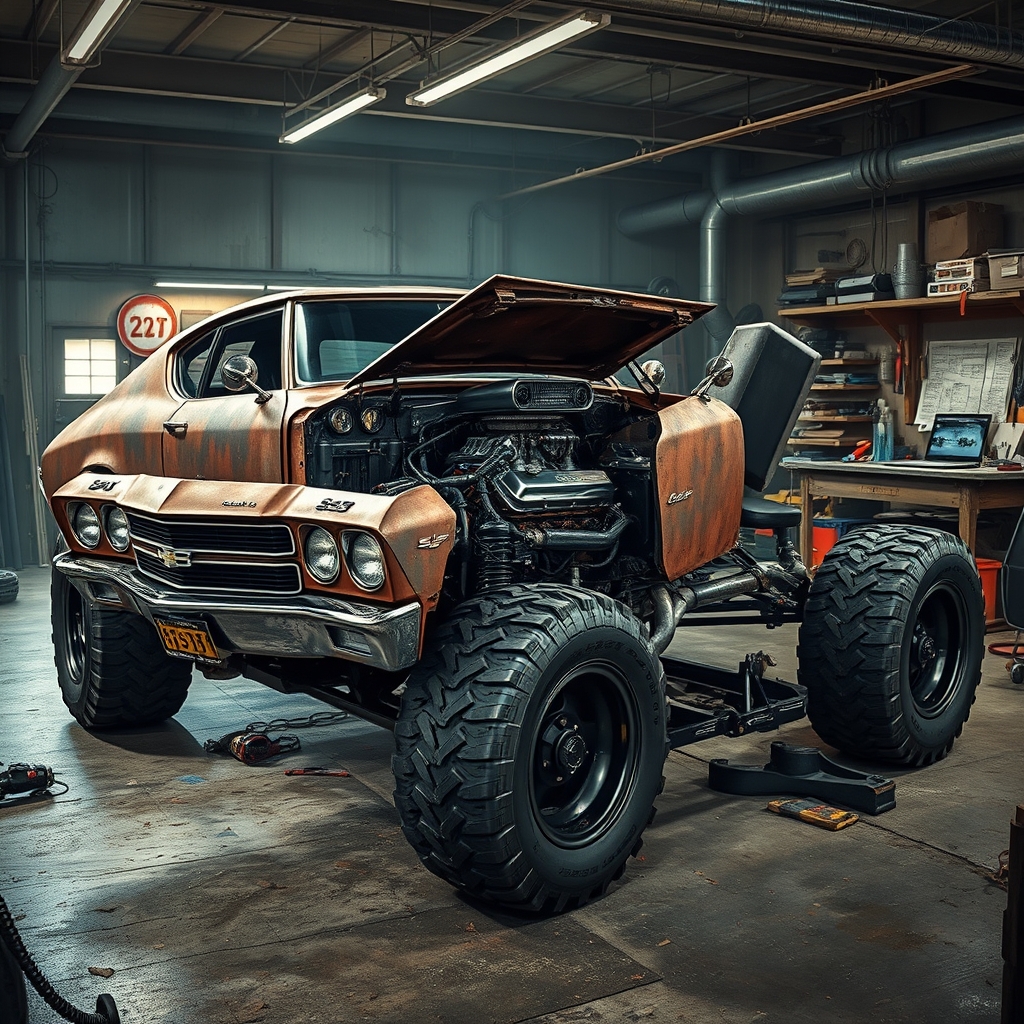
Every legendary monster car starts with a spark—an idea, a sketch, or sometimes just a wild dream. For many builders, the journey begins in a garage, surrounded by tools, half-finished projects, and a vision that refuses to stay contained. Take, for example, the story of Mark Jenkins, the mastermind behind the infamous “Beast from the East,” a 1970 Chevrolet Chevelle that looks like it was forged in the depths of a Mad Max wasteland. Jenkins, a former mechanic turned full-time custom builder, describes his process as a mix of obsession and intuition. “I don’t start with a blueprint,” he admits. “I start with a feeling. I want people to look at this car and feel something—fear, awe, maybe even a little envy.”
Jenkins’ Chevelle is a testament to what happens when raw power meets artistic flair. The car’s exterior is a patchwork of salvaged metal, rusted panels, and custom-fabricated bodywork, all welded together to create a look that’s equal parts post-apocalyptic and steampunk. Under the hood, a 632-cubic-inch big-block Chevy engine roars to life, producing over 1,000 horsepower and a sound that rattles windows a block away. But the build wasn’t without its challenges. Jenkins recalls spending months sourcing rare parts, battling electrical gremlins, and nearly scrapping the project after a catastrophic engine failure. “There were times I wanted to walk away,” he says. “But then I’d remember why I started—because I wanted to build something no one had ever seen before.”
From Junkyard to Showstopper: The Transformation
Not all monster car builds start with a pristine donor vehicle. Some of the most impressive creations begin their lives as forgotten relics, pulled from junkyards or abandoned barns. Such was the case for “The Phoenix,” a 1967 Ford Mustang that rose from the ashes of neglect to become one of the most talked-about custom builds of the decade. The car’s owner, Lena Rodriguez, a former aerospace engineer turned custom car builder, saw potential in the rusted hulk where others saw only scrap metal. “I found it in a field, half-buried under weeds,” she recalls. “The body was shot, the frame was twisted, and the engine was seized. But the lines of the car—they were still there. I could see what it could become.”
Rodriguez’s vision for The Phoenix was to blend classic muscle car aesthetics with modern performance and technology. The result is a car that looks like it rolled off the assembly line in 1967 but performs like a 21st-century supercar. The exterior features a custom-mixed “molten bronze” paint job that shifts color in the sunlight, while the interior is a mix of vintage leather and carbon fiber, with a digital dashboard that wouldn’t look out of place in a spaceship. Under the hood, a supercharged Coyote V8 engine delivers 800 horsepower, propelling the Mustang from 0 to 60 in under 3 seconds. The build took Rodriguez and her team over two years to complete, with countless setbacks along the way, including a fire that nearly destroyed the car mid-restoration. “We had to start over on the interior,” she says. “But every setback just made the final product that much sweeter.”
The Challenges of Building a Monster
Creating a monster car isn’t for the faint of heart. Builders face a laundry list of challenges, from sourcing rare parts to navigating the complexities of custom fabrication. One of the biggest hurdles is often the simplest: space. Most builders don’t have access to a state-of-the-art shop, so they make do with cramped garages, backyard sheds, or even rented storage units. Darius Cole, the builder behind the “Midnight Marauder,” a heavily modified 1987 Buick Grand National, knows this struggle all too well. “I built the first version of this car in my mom’s garage,” he laughs. “There were times I had to take the doors off just to fit the engine hoist in there.”
The Midnight Marauder is a study in contrasts—a sleeper that looks unassuming at first glance but hides a twin-turbocharged V6 engine capable of producing over 700 horsepower. Cole’s goal was to create a car that could blend into traffic but dominate on the drag strip. Achieving that balance required meticulous planning and a willingness to experiment. “I went through three different turbo setups before I found the right combination,” he says. “And don’t even get me started on the fuel system. I must have replaced the fuel pump four times before I got it right.”
Another common challenge is budget. Monster car builds can quickly spiral into money pits, with costs ballooning as builders chase perfection. Jenkins estimates he spent over $150,000 on the Beast from the East, while Rodriguez’s Phoenix came in just under $200,000. For many builders, the financial strain is the price of pursuing a passion. “You don’t build a car like this to make money,” says Cole. “You do it because you love it. And if you’re lucky, you might break even when you sell it.”
Before and After: The Magic of Transformation
Few things capture the magic of a monster car build like a before-and-after comparison. These transformations are a testament to the skill, patience, and creativity of the builders who bring them to life. Take, for instance, the story of “The Green Goblin,” a 1972 Volkswagen Beetle that was rescued from a scrapyard and turned into a street-legal dune buggy with a 500-horsepower LS engine swap. The car’s owner, Eliott Park, a former stunt driver, wanted to create a vehicle that could handle both the streets and the sand. “I found the Beetle in a junkyard in Arizona,” he says. “It was missing its engine, the floor pans were rusted through, and the roof was caved in. But the price was right—$500.”
Park’s vision for The Green Goblin was to create a car that looked like it belonged in a sci-fi movie. The final build features a custom tube chassis, a wide-body kit, and a vibrant lime-green paint job that glows under blacklight. The interior is minimalist, with racing seats and a roll cage, while the exterior is adorned with LED lights and a custom front bumper that gives the car a menacing grin. The transformation took Park and his team over a year to complete, with countless hours spent fabricating custom parts and fine-tuning the suspension. “The first time I took it out on the sand, I knew it was worth it,” he says. “It handled like a dream, and the reaction from people was priceless.”
The Builders Behind the Monsters
Behind every monster car is a builder—or a team of builders—who pour their heart and soul into the project. These individuals come from all walks of life, from professional mechanics to weekend warriors, but they share a common trait: an unrelenting passion for cars. For some, building is a way to honor a family legacy. For others, it’s a form of self-expression, a way to turn their wildest ideas into reality. And for a lucky few, it’s a career that allows them to do what they love every day.
One such builder is Sophia Nguyen, the creative force behind “The Valkyrie,” a custom 1969 Dodge Charger that blends Norse mythology with modern muscle car performance. Nguyen, a former graphic designer, left her corporate job to pursue her dream of building custom cars. “I grew up watching my dad work on cars,” she says. “He had this old Charger in the garage, and I always dreamed of restoring it. When he passed away, I decided to build it in his honor.”
The Valkyrie is a sight to behold, with a custom “battle-worn” paint job that mimics the look of aged metal, complete with hand-painted Norse runes and mythological scenes. The car’s interior is equally impressive, featuring hand-stitched leather seats, a custom dashboard with a digital display, and a sound system that can rattle fillings. Under the hood, a 6.4-liter Hemi V8 engine delivers 600 horsepower, while a custom exhaust system gives the car a deep, growling tone. Nguyen’s attention to detail is evident in every aspect of the build, from the custom-fabricated suspension to the hand-forged metalwork. “This car is more than just a project,” she says. “It’s a tribute to my dad, and to the love of cars that he passed down to me.”
These builders remind us that monster car builds are more than just machines—they’re a labor of love, a testament to human ingenuity, and a celebration of the endless possibilities that come from daring to dream big. Whether it’s a post-apocalyptic Chevelle, a resurrected Mustang, or a mythological Charger, each of these creations tells a story. And as long as there are builders willing to push the limits, the world of custom cars will continue to evolve, surprise, and inspire. The next time you see a car that makes you do a double-take, remember: it didn’t start out that way. Someone, somewhere, looked at a pile of metal and saw something extraordinary.